



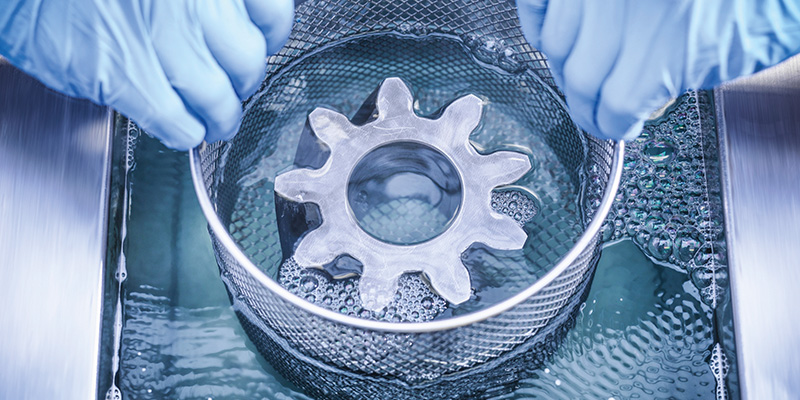
Industrial cleaning is the removal of unwanted contaminants such as oil, grease, swarf, polishing compounds, oxides and particles from part surfaces, so that subsequent processes (coating, painting, welding, assembly or packaging) are not adversely affected. Immersion and ultrasonic baths are among the most widely used and reliable methods in industry, as they bring the cleaning solution into contact with the entire part surface, blind holes and complex geometries.
Immersion Baths
In immersion cleaning, parts are kept in the cleaning solution long enough for the contaminants to dissolve or disperse. It is a simple and economical method that requires little labour. Solution circulation, agitation of the parts and increased temperature significantly shorten cleaning time. Water-based baths can be heated, whereas solvent-based baths must be kept away from heat sources and ignition sources.
Ultrasonic Cleaning
In ultrasonic cleaning, transducers attached to the tank generate sound waves, typically in the 25–40 kHz range for industrial applications. These waves create microscopic bubbles in the liquid; their sudden collapse (cavitation) produces an intense mechanical cleaning action on the part surface. Combined with the dissolving power of the chemistry, cavitation reaches areas that cannot be cleaned by hand, such as blind holes, threads and narrow channels. Higher frequencies are preferred for delicate surfaces to reduce the risk of surface damage.
Process Parameters for Reliable Cleaning
Successful cleaning depends as much on correctly set process parameters as on chemical selection:
- Chemical selection and concentration: Determined by contaminant type and part material; typical dosage is 1–10% depending on the product.
- Temperature: Water-based ultrasonic processes usually perform best between 50–70 °C.
- Time: From a few minutes up to 15–20 minutes depending on the soil load.
- Degassing: A freshly prepared bath should be run in degas mode before use, so dissolved gases do not weaken cavitation.
- Rinsing and drying: Rinse, preferably with deionised (DI) water, to avoid chemical residues, then dry with hot air or vacuum. A corrosion inhibitor can be added to the final rinse if required.
- Bath monitoring: Concentration, pH and oil load should be checked regularly; the bath should be replenished or renewed in time.
Our Product Groups
At Molkim, we offer water-based cleaning chemicals for ultrasonic, immersion and spray washing processes:
- Alkaline cleaners: Removal of organic soils such as oils, greases, cutting fluids, polishing and lapping compounds
- Neutral cleaners: Gentle cleaning of sensitive metals such as aluminium, copper, brass and zinc
- Acidic cleaners: Removal of oxides, scale, rust and inorganic residues, and brightening of metal surfaces
- Precision pre-coating cleaning: Residue-free surface preparation before PVD/CVD and electroplating
- Corrosion-inhibiting rinse additives: Temporary protection of parts after cleaning
Typical Applications
- Ultrasonic bath cleaning solutions and ultrasonic cleaning detergents
- Residue-free cleaning of laboratory glassware and quartz
- Cleaning of optical, electronic and precision mechanical parts
- Pre-treatment and precision cleaning before PVD/CVD coating
- Removal of polishing paste, lapping and buffing compound residues
- Removal of cutting oil, soluble (boron) oil and machining fluid residues
- Degreasing of parts after machining and pressing
- Rust and oxidation removal, removal of oxide layers and tarnish
- Cleaning of carbonised and burnt-on oil residues and slag deposits
- Intermediate cleaning between process steps in precision part manufacturing
Technical Information
- pH classes: Alkaline (generally pH 10–13), neutral (pH 6–9) and acidic (pH 1–4) cleaners
- Form: Liquid concentrates diluted with water
- Application: Ultrasonic, immersion and spray washing
- Material compatibility: Stainless steel, steel, aluminium, copper alloys, glass and ceramics; product selection by material
- Documentation: Safety Data Sheets (SDS) compliant with KKDİK/CLP
Frequently Asked Questions
Which cleaning solution should I use in an ultrasonic bath?
Alkaline cleaners are preferred for organic soils (oil, grease, compounds), neutral cleaners for sensitive metals, and acidic cleaners for inorganic soils such as oxides and scale. Share your part material and contaminant type, and we will select the right product together.
Can carbonised and burnt-on residues be removed in an ultrasonic bath?
Yes. Highly alkaline cleaners, the right temperature and ultrasonic cavitation are combined for carbonised oil, burnt-on residues and slag deposits. For heavy deposits, a pre-soak period significantly improves the result.
What matters in cleaning before coating?
No oil, film or chemical residue should remain on the surface. Multi-stage rinsing with purified water and controlled drying are therefore recommended after cleaning.
Contact our technical team to select the right chemistry for your part material, contaminant type and equipment, to run trials on sample parts and to optimise your process parameters.